
.png)
RP2350B-Based AI Environment Kit
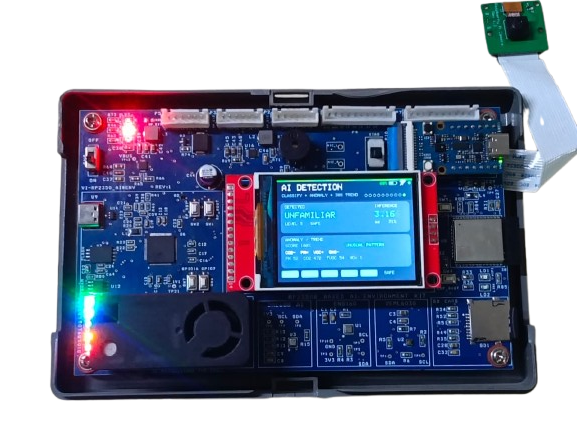
RP2350B-Based AI Environment Kit:
The RP2350B-Based AI Environment Kit is an advanced environmental monitoring and Edge AI development platform powered by the Raspberry Pi RP2350B processor. It integrates multiple environmental sensors, on-device TinyML inference, wireless connectivity and a real-time TFT display for intelligent indoor air-quality monitoring. With a dedicated Android application, rechargeable battery, MicroSD data logging and hardware expansion interfaces, it is suitable for AI-based environmental analysis across homes, classrooms, restaurants, industrial environments and battery storage rooms.
- RP2350B Processor: Dual-core Arm Cortex-M33 and dual-core Hazard3 RISC-V architecture.
- Memory: 16 MB onboard Flash and 8 MB PSRAM for application data and supported AI workloads.
- Environmental Sensors: BME688 AI gas sensor, ENS160 air-quality sensor, Sensirion SEN66 environmental sensor and VEML6030 ambient light sensor.
- Air-Quality Monitoring: Temperature, humidity, pressure, PM1, PM2.5, PM4, PM10, VOC Index, NOx Index, eTVOC and eCO₂, according to the selected sensor outputs.
- Display and Indicators: 2.4-inch TFT colour display and five onboard LEDs for real-time visualization and status indication.
- Wireless Connectivity: ESP32-WROOM-32 coprocessor with Wi-Fi and Bluetooth connectivity, communicating with the RP2350B through UART and SPI.
- Android Application: Dedicated application for real-time environmental readings, air-quality monitoring and battery status.
- Battery and Power Management: 5000 mAh rechargeable battery, TI BQ25302RTER battery charger and TPS63060 buck-boost converter.
- Data Logging and RTC: MicroSD card interface for data logging and a battery-backed real-time clock.
- Expansion Interfaces: XIAO-compatible expansion footprint, general-purpose headers, GPIO, I²C, SPI, UART and ADC interfaces, subject to pin allocation.
- TinyML and Edge AI: Local inference for environmental classification, anomaly detection, sensor-data analysis and application-specific AI models.
- Application Areas: Battery storage rooms, rice mills, classrooms, homes, AC restaurants, offices, warehouses and smart-building environmental monitoring.
- Edge AI Advantage: Enables local processing of environmental data to reduce communication bandwidth and inference latency while supporting privacy-aware monitoring and future IoT integration for HVAC and lighting control.
SPECIFICATIONS :
Note: Actual AI performance depends on the deployed model, available memory and validated training data. Hazardous-gas detection requires appropriate dedicated sensors and safety validation.